

Kiss of Life: A Sculpture About Love, Desire, and the Soul
There are kisses that remain on the lips, and there are kisses that pass through the entire body.
Kiss of Life was born from the feeling of that deeper kiss: the one that does not simply touch, but enters. A kiss can be an opening, a threshold, a moment when two beings move beyond the privacy of their own form and begin, briefly, to inhabit one another. It can be tender, erotic, spiritual, urgent, restorative. It can feel like breath returning to the body.
This sculpture is my meditation on that exchange.
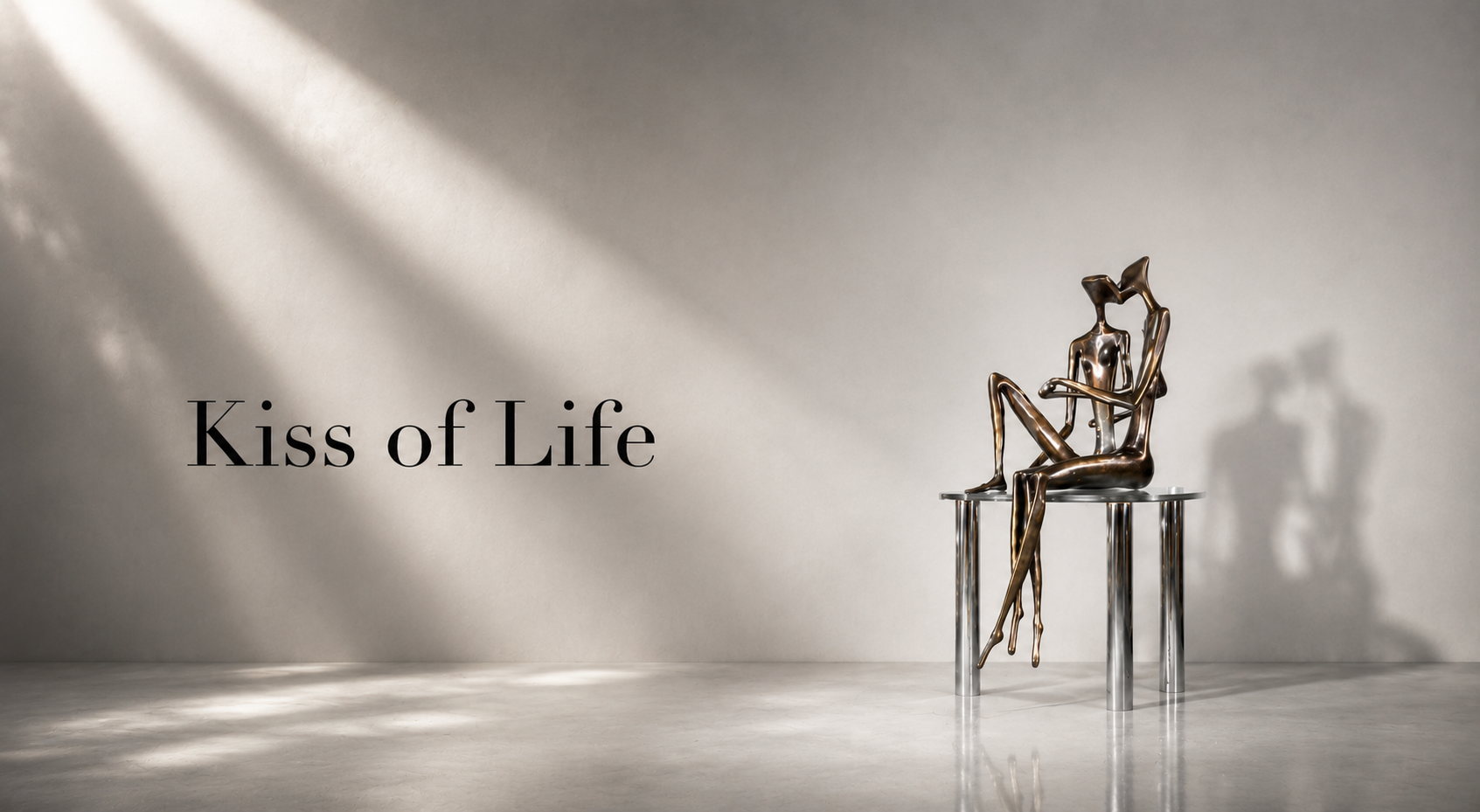
In Kiss of Life, two elongated figures meet in a kiss that becomes the emotional center of the work. Their bodies are stretched, almost lyrical, as if desire has drawn them upward and inward at the same time. The forms are not literal portraits of lovers. They are more like essences: bodies transformed by feeling, shaped by longing, polished by contact.
The kiss holds three meanings for me.
The first is the kiss of the soul. This is the kiss that recognizes. It is not only about attraction, though attraction may be present. It is the moment of being seen beyond the surface of the body, beyond language, beyond performance. It is the kiss that says: I know something in you, and something in me answers.
The second is the kiss of life. A kiss can revive us. It can call us back from distance, numbness, or solitude. In myth and fairy tale, the kiss awakens; in life, it often does something more subtle and more profound. It reminds us that we are embodied. That we are capable of heat, vulnerability, surrender, and response. It returns breath to the places within us that have gone quiet.
The third is the kiss of desire. Desire is one of the great animating forces of existence. It pulls us toward beauty, toward risk, toward union, toward transformation. In this sculpture, desire is not treated as something crude or merely physical. It is refined into line, tension, curve, and balance. The bodies lean into one another, but they also retain their own mystery. They meet, but they are not consumed. That space between them matters.
I am always interested in the charged space between forms. The places where bodies almost touch can be as powerful as the places where they do. In Kiss of Life, the negative space around the figures becomes part of the intimacy. It holds anticipation. It holds breath. It allows the viewer to feel the pause, the approach, the surrender.
The surface of the sculpture reflects light across the limbs and torsos, creating a sense of movement even in stillness. Light travels over the figures the way touch travels over skin. The polished surface gives the work a living quality, shifting as the viewer moves around it. From one angle, the sculpture feels tender. From another, it becomes more erotic, more charged, more insistent. That changing experience is important to me. Love is never one thing from every angle.
As a contemporary figurative sculpture, Kiss of Life belongs to a long artistic conversation about intimacy, the body, and human connection. The kiss has appeared throughout art history as a symbol of romance, betrayal, blessing, awakening, and desire. But I wanted this piece to move beyond the illustration of a kiss. I wanted the kiss itself to become a force, almost an architecture, something capable of shaping the bodies around it.
The figures in Kiss of Life are elongated because I wanted them to feel lifted out of the ordinary. Their proportions move toward the dreamlike. They are human, but not bound entirely by realism. In that distortion, I find emotional truth. Desire does not always feel proportionate. Love does not always feel contained. A kiss can make the body feel larger, stranger, more luminous than it was a moment before.
For me, sculpture is a way of giving form to invisible experiences. We cannot hold longing in our hands. We cannot see the exact shape of recognition, or the instant when desire becomes tenderness. But through bronze, gesture, balance, and line, we can approach those experiences. We can give them a body.
Kiss of Life is ultimately about intimacy as transformation. It is about the moment when touch becomes communion, when the physical opens into the spiritual, when desire becomes a language of its own. The sculpture asks the viewer to consider what a kiss can carry: breath, memory, hunger, devotion, surrender, and the possibility of being changed by another person.
A kiss can be brief. It can last only a second.
And yet, in that second, an entire world can pass between two souls.

Kiss of Life contemporary figurative sculpture of two elongated bronze figures kissing.
© Gesso Cocteau


