

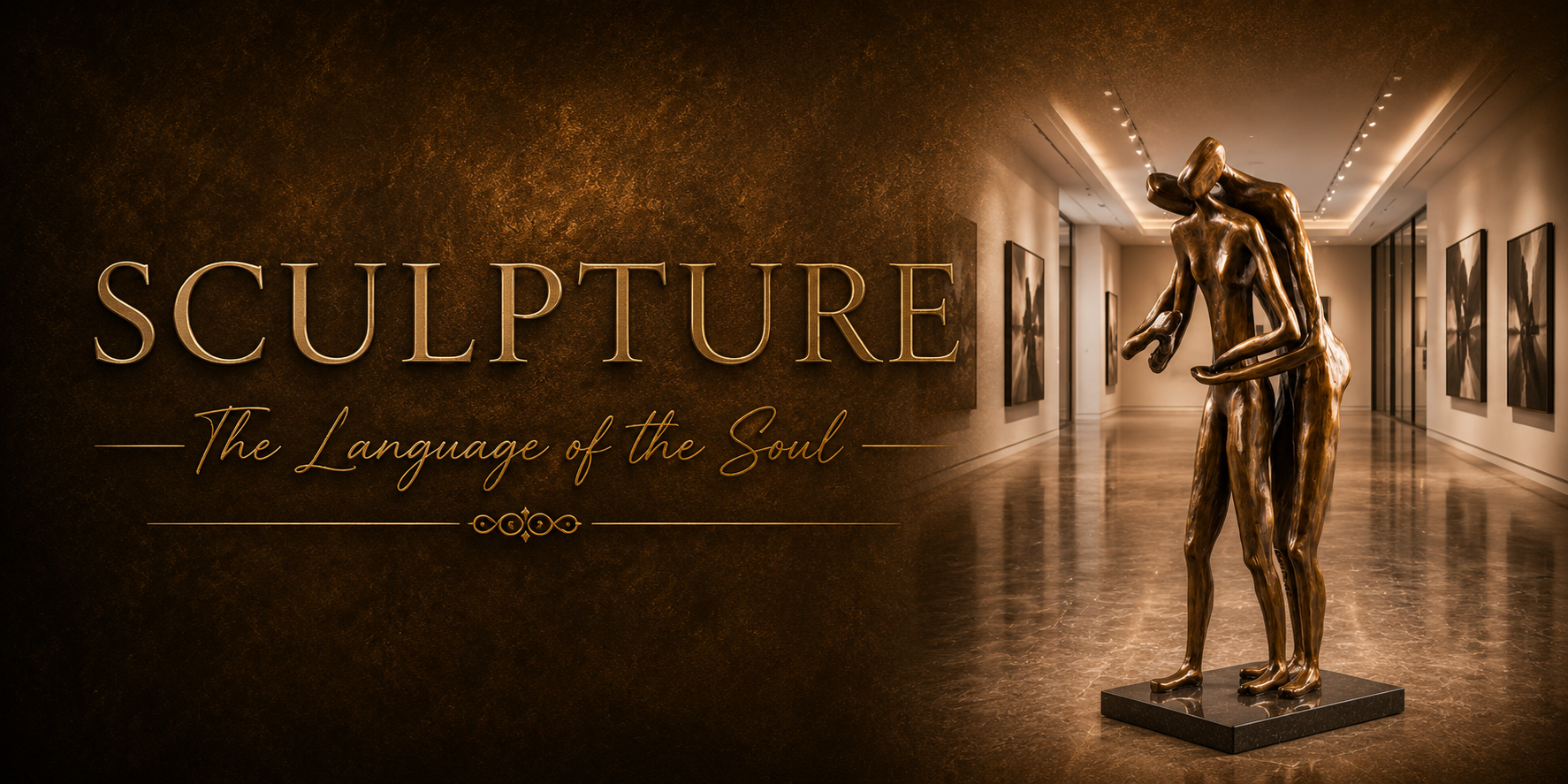
Sculpture and the Language of the Soul
Human beings responded to sculpture long before they understood written language. Before there were alphabets, manifestos, philosophies or cathedrals, there was the body. The curve of a spine. The lift of a chin. The protective gesture of a mother holding a child. The poised stance of a hunter. Sculpture was one of humanity’s first forms of communication because it translated emotion into physical presence. It gave shape to fear, fertility, power, grief, ecstasy and love.
The earliest sculptures discovered, such as the Venus figurines carved more than thirty thousand years ago, reveal something profound about human consciousness. Even in the beginning, humanity was compelled to transform emotion and instinct into form. These primitive sculptures were not merely decorative objects. They were symbols, prayers, talismans, memory. They carried meaning beyond words. The body itself became language.
Perhaps this is why sculpture continues to move us so deeply. We do not simply look at sculpture. We recognize ourselves within it.
The subconscious mind responds immediately to gesture and posture. Long before we intellectually interpret a sculpture, the nervous system has already begun reading it. A bowed head suggests sorrow or contemplation. An arched back can imply ecstasy, defiance or surrender. Two forms leaning toward one another evoke intimacy even before the conscious mind identifies the emotion. Sculpture bypasses language and enters us through instinct.
This silent communication is ancient.
We are creatures profoundly attuned to body language. Human survival once depended upon reading physical cues quickly and accurately. The slightest movement of the shoulders, hands or eyes could reveal danger, desire, trust or betrayal. Sculpture preserves this primal vocabulary. Bronze, marble and clay become vessels for emotional memory.
Alberto Giacometti once said, “The object of art is not to reproduce reality, but to create a reality of the same intensity.”
This intensity is precisely what great sculpture achieves. It does not imitate life mechanically. It distills human presence into something essential. Giacometti’s elongated figures seem almost consumed by existence itself, fragile and infinite at once, like souls crossing through time. They feel less like statues and more like psychological echoes.
Henry Moore understood sculpture as something deeply connected to humanity’s relationship with nature and shelter. He wrote, “Sculpture is an art of the open air. Daylight, sunlight is necessary to it.”
Moore recognized that sculpture lives physically in the same world we inhabit. It shares our light, our shadows, our weather. Unlike painting, sculpture occupies space as we do. It stands beside us. It confronts us bodily. We walk around it as we walk around one another. In this way, sculpture becomes almost relational, less an image than a presence.
Germaine Richier brought another dimension to sculpture, one that fascinates me deeply: the fusion of humanity and transformation. Her figures often appear suspended between the human and the mythic, between flesh and spirit, beauty and ruin. She understood that the body carries not only physical form but psychological history.
When I sculpt, I think of bronze as a kind of poem written into matter.
The process itself feels ancient to me. The molten metal, the fire, the transformation from clay to permanence. Sculpture is born through destruction and rebirth. Wax disappears. Fire consumes. Bronze emerges. There is something profoundly symbolic in this ritual, something almost alchemical.
I often think of women weaving stories into tapestries centuries ago, encoding memory, devotion, warnings and longing into thread. Sculpture feels similar to me. Gesture becomes syntax. Form becomes emotional narrative. The tilt of a figure’s shoulders can say what language cannot. A hand extended outward can become an offering, a prayer or an act of desire.
Every sculpture contains a hidden interior life.
Even stillness speaks.
This may be why sculpture survives civilizations. Long after languages disappear and empires collapse, the human body remains understandable. We still recognize tenderness in a mother holding a child carved thousands of years ago. We still understand anguish in the tension of a figure bent in grief. The body transcends time.
And perhaps this is the deepest reason humans respond to sculpture: because sculpture reminds us that emotion itself has shape.
It gives permanence to fleeting states of being. Desire becomes bronze. Love becomes marble. Sorrow becomes stone. The invisible life within us is suddenly given weight, shadow and form.
Sculpture allows humanity to touch its own consciousness.
Not only through intellect, but through instinct, memory and the mysterious language of the soul itself.
©Gesso Cocteau
 The Journey
by Gesso Cocteau
Limited Edition of 8


1 comment
Dear Gesso…. I feel speechless after reading what the universe of your mind has put into words… and now as such my speechless void that lingers is complete just the same because I traveled in that universe that is you my friend! … and I deeply thank you for that journey that is timeless……