

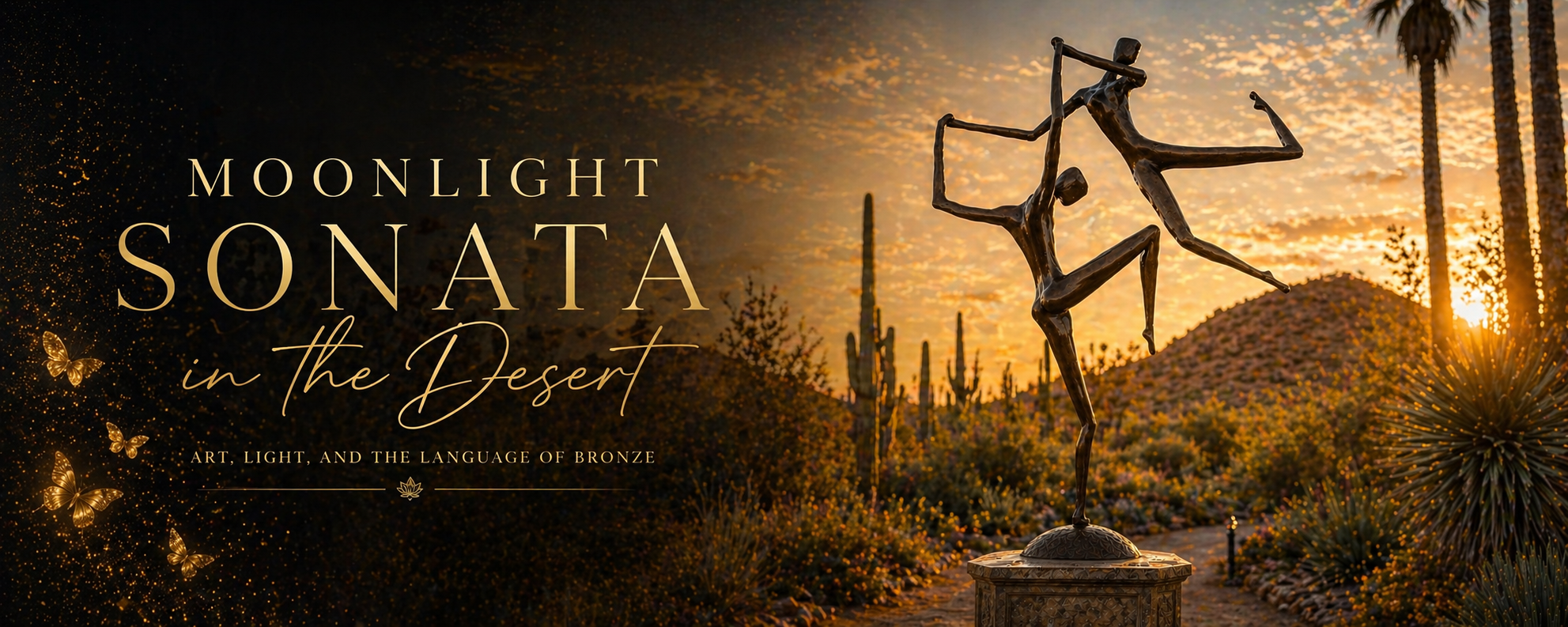
Moonlight Sonata at the Desert Botanical Garden
There is a quality of light in the Sonoran Desert that does not belong to anywhere else.
It does not fall.
It arrives.
At golden hour it moves sideways, almost parallel to the earth, as though gravity has loosened its hold. It does not illuminate. It ignites.
This is where bronze changes.
Bronze remembers weight.

It remembers the ore, the fire, the pour, the long surrender into stillness. Every sculpture begins in that resistance, in the quiet argument between motion and mass. To make a figure move in bronze is to persuade it to forget what it is.
And yet,
In this light, it does.
When I saw Moonlight Sonata among the saguaros, something shifted. The sun did not strike the surface, it traveled it. It moved along the limbs, entered the spaces between the figures, and the sculpture opened. What was cast became breath.
The dancers have always lived in that suspended reach, that moment before touch. But here, they cross into something else. Not arrival, something more fleeting.
Release.
The bronze remembers it was once fire.
Beethoven understood this tension. In his sonata, the left hand holds, steady, inevitable, while the melody lifts free, luminous, untethered. The structure remains, but something within it escapes.
This is what I ask of sculpture.
The pedestal holds.
The figures refuse.
And the desert light becomes the only place where that refusal is complete.
That this work stands in a botanical garden feels inevitable. Nothing here is obedient. The saguaro rises where it should not. Flowers bloom from thorn. Life insists in forms that defy expectation.
Moonlight Sonata belongs to that language.
Stillness that moves.
Weight that lifts.
Bronze that remembers how to become air.
© Gesso Cocteau


