There is a very old poem that inspired this piece.
Married Love
You and I
Have so much love,
That it
Burns like fire,
In which we put into the fire the clay
Molded into a figure of you
And a figure of me.
Then we take both of them,
And break them into pieces,
And mold again a figure of you,
And a figure of me.
I am in your clay.
You are in my clay.
In life we share a single quilt.
In death we will share one bed.
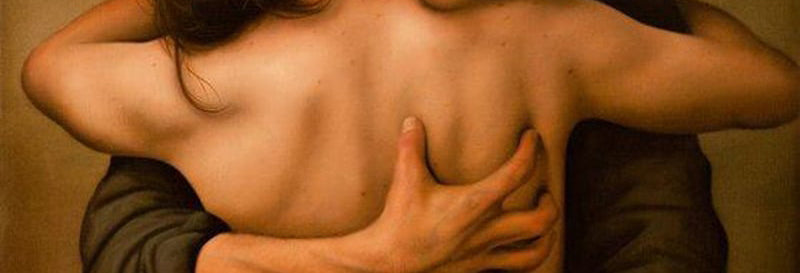
One of the deepest human yearnings is to connect with another human being. To be inextricably linked to another soul. “The deep desire for love, to be one with another on all levels, crosses all times and boundaries.” It is interesting to note that from ancient times clay has been associated with the human body.
Poem by Kuan Tao Sheng
Poem translated by Kenneth Rexroth
Kuan Tao Sheng lived from 1262 to 1319, she was a Chinese painter best known for her images of nature and her tendency to inscribe short poems on her paintings.
I have never experienced sculpture and poetry as separate disciplines.They are two expressions of the same act of attention.
My sculptures begin as observations of the human condition, not as it is performed, but as it is lived. The quiet lean of one body toward another. The tension between longing and restraint. The moment where love steadies us or undoes us. I am less interested in spectacle than in recognition: the instant when someone sees themselves inside a form and feels understood without explanation.
Sculpture, for me, is a language of the body.Poetry is the same language, spoken inward.
When I sculpt, I am listening with my hands. Bronze carries memory. It holds weight, resistance, gravity, just as we do. The human figure becomes a site of inquiry: how we endure, how we reach, how we protect ourselves, how we surrender. The surface matters, but what lives beneath the surface matters more. What is unspoken. What is held.
My poetry often arrives after the sculpture, as if the work has loosened something that needs words. Other times, the poem comes first, a line, an image, a truth that insists on being felt before it can be seen. In those moments, the sculpture follows the poem like a body following breath. Each informs the other. Each sharpens the question.
There is a conversation constantly unfolding between these two forms.The sculpture teaches the poem about silence.The poem teaches the sculpture about vulnerability.
I think of my work, whether cast in bronze or written in lines, as acts of witnessing. To love is to witness. To create is to witness. To stand still long enough for the moment to speak.
I am drawn to themes of devotion, resilience, sensuality, and the unguarded spaces between people. The human condition is not abstract to me, it is intimate. It lives in posture, in proximity, in the way two figures can hold an entire history without narrative. My figures are often grounded, rooted to the earth, because love is not an idea, it is something we carry in our bodies.
Over time, I have come to understand that my sculptures are poems that refuse to speak, and my poems are sculptures that refuse to stand still. They exist in a shared field of meaning, each one asking the same essential questions:
How do we live inside love?How do we survive longing?What does it mean to remain open in a world that asks us to close?
The image accompanying this piece captures me as I am most often found, observing, listening, inhabiting the space between thought and form. It is there, in that in-between, where my work lives.
Art, for me, is not about answers.It is about staying with the questionand allowing it to take shape.
Gesso CocteauSculptor & Poet
In the language of clay, love is never still,it keeps forming us, endlessly, into Forever.
Forever
(for the Viking)
In the beginning, there was only clay and breath,the quiet surrender between two forms learning how to be one.Every curve, every reach, remembers touch,not the touch that ends, but the kind that begins againeach time one heart leans toward another.
I call this Forever because it carries the weight of love that has no edge,no border between body and spirit, giver and receiver.It is the moment before bronze,when the pulse of creation is still visible,alive beneath the fingertips that shaped it.
Here, they stand,not as man and woman, not even as figures,but as the echo of devotion itself.A reminder that love is never still;it keeps forming us, over and over,until we recognize ourselvesin the arms of another.
— Gesso Cocteau
This is Forever in the foundry completed in clay and before the mold is made. I will post the piece when it is completed in Bronze.