

Artist Journal
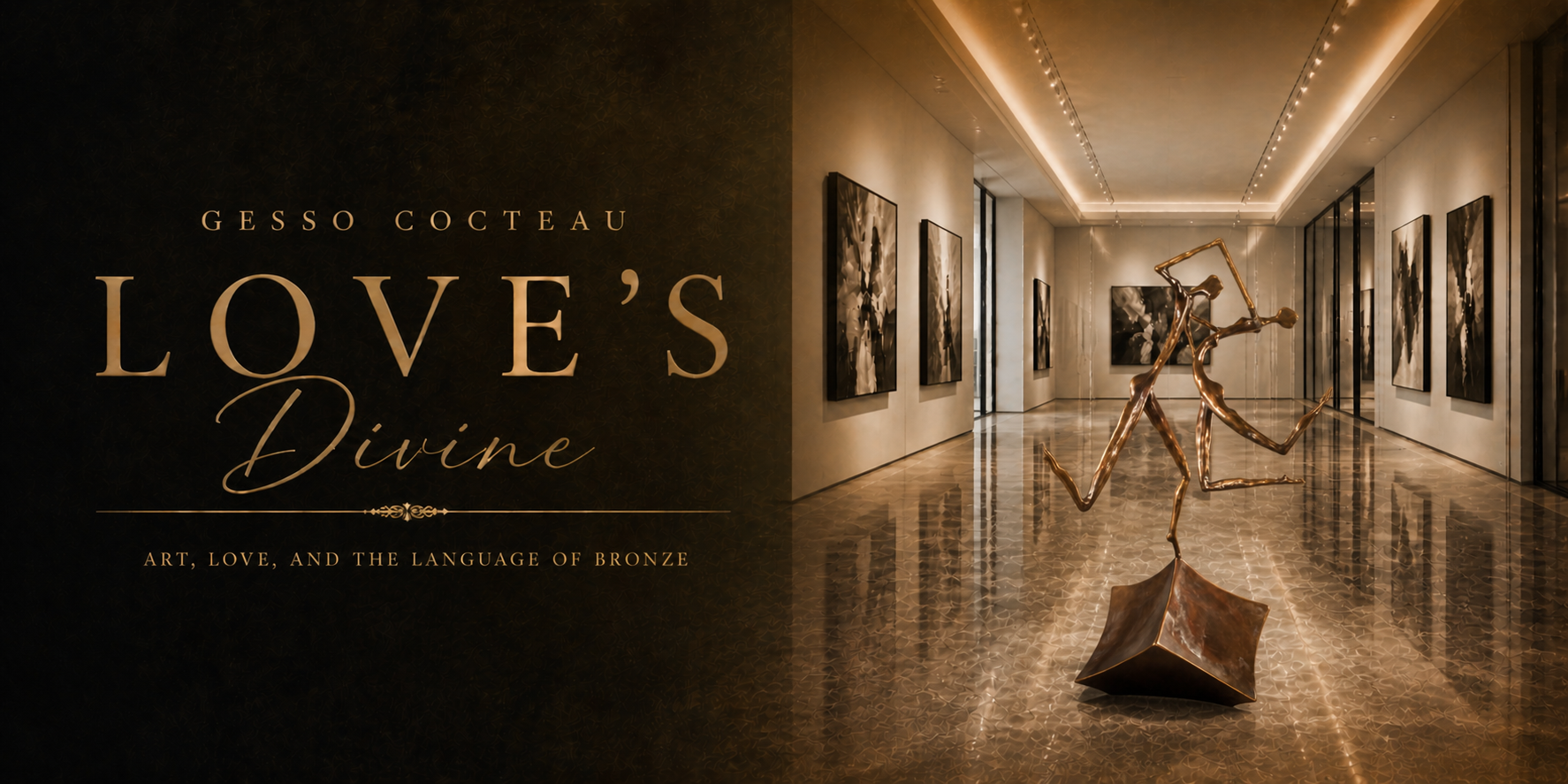

Desire
Desire Desire is not the body reaching. It is the soul rememberingwhat it once touchedbefore language divided the worldinto longing and restraint. These two figures stand facing one anotherin the stillness before surrender.They are not yet embraced.They are not yet lost.They are held in the unbearable tendernessof almost. Their hands meetwhere the visible world becomes dangerous.Not in possession.Not in demand.But in recognition. Desire begins there,in the small charged spacebetween one hand and another,where the body knowsbefore the mind dares to speak. I have always believedthe body carries truthswe spend our lives trying to translate.A tilt of the head.A shoulder turned inward.The quiet architecture of need. In Desire,the figures are both vulnerable and restrained,bowed toward one anotheras if listening to something older than touch.They do not rush.They do not perform.They stand inside the gravityof what is awakening between them. This is not lust alone,though lust is sacredwhen it is honest. This is the moment desire becomes reverence. The bronze holds the tension:the ache of wanting,the discipline of waiting,the fragile courageof allowing oneself to be seen. There is a humility in their posture,as if each figure understandsthat to desire anotheris to stand before a mysteryyou cannot own. You can only approach.You can only offer your hands.You can only become still enoughto feel what passes through you. Desire is not weakness.It is the pulse of creation itself. Every sculpture begins in desire.Every poem.Every kiss.Every prayer sent into the darkwith no guarantee of answer. To desire is to admitthat we are unfinished.That something beyond uscalls the body forward.That longing is not a flaw,but a doorway. These figures do not askto be completed by one another.They ask to be witnessed. And perhaps that is the deepest intimacy:not to consume,not to conquer,but to stand before another soulwith open handsand say without speaking, I feel the world changingbecause you are near. Desire is the space before touch becomes fate. The breath before love becomes form. The moment the body bowsto what the soul already knows. © Gesso CocteauPoetry and Sculpture by Gesso Cocteau

Da Brava Madre
Da Brava Madre (The Good Mother) There are sculptures that describe the body, and there are those that attempt something far more elusive to give form to a force we recognize instantly yet cannot fully name. Da Brava Madre (The Good Mother) belongs to the latter. Mother is not simply a role. It is an origin story written into the body before language, before memory. It is the first architecture we inhabit the pulse that surrounds us, the quiet intelligence that knows when to hold and when to release. Long before we understand love, we are carried by it. In Da Brava Madre, the figures do not rest they move. They reach, extend, balance in a moment that feels both precarious and perfectly resolved. This is intentional. Motherhood is never static. It is a continual act of adjustment, of instinct meeting circumstance, of strength disguised as grace. The elongated limbs stretch outward like branches in wind, echoing the way a mother becomes more than herself. She multiplies not physically, but energetically becoming protector, teacher, shelter, and horizon. The smaller forms are not separate; they orbit, lean, and rise through her, suggesting that a child is never outside the field of a mother’s presence, even when they begin to stand on their own. There is play here. You can feel it in the lift of a limb, the suggestion of motion that borders on dance. Mothers do not only guard they delight. They mirror laughter, invent games, soften the world so a child can enter it without fear. The sculpture holds that fleeting, sacred lightness the moment when protection becomes joy. And yet, beneath the movement, there is an undeniable core of strength. The single point of contact with the earth the grounded leg anchors everything. This is the quiet truth of motherhood while everything else reaches, expands, and risks, there is always one part that remains rooted. Steady. Unyielding. A foundation that does not announce itself, but without which nothing could stand. To protect is not only to shield from harm. It is to prepare. To guide. To allow small falls so that greater strength may grow. In this sense, the sculpture becomes a study in balance not just physical, but emotional. How much to hold, how much to let go. How to remain a center while encouraging departure. The surface of the bronze carries its own memory fire, transformation, time. It mirrors the journey of motherhood itself an alchemy of intensity and patience, where something raw is shaped into something enduring. Every contour suggests both vulnerability and resilience, as though the figures have been forged not just in metal, but in experience. This is why Da Brava Madre was created. Not to depict a literal mother and child, but to embody the essence of motherhood the invisible thread that binds, lifts, protects, and ultimately releases. It is a love that does not diminish when stretched; it expands. It is fierce without hardness, tender without fragility. It is, in its truest form, an act of becoming. And perhaps that is what we recognize when we stand before it not just the mother, but the memory of having been held, taught, and set free. Have a Beautiful Day, Gesso Cocteau (From my journal notes on creating 'Da Brava Madre'.) Da Brava Madre (The Good Mother) Limited Edition of 25

Golden Butterflies
The Golden Butterflies It starts before you touch the door, a gilded frequency, like a secret with teeth. You enter, and the yellow butterflies enter with you, a thousand mouths of wanting, not beauty, not omen, but appetite. They don’t bite. They do worse. They cover. They turn the air into weight, a living curtain closing around the bed, brushing my skin with the heat of a fever that you call devotion. But a fire this hot changes the physics of a room. The closer you press with the gravity of your earth, the more I draw my light into the trees and make a wilderness of myself. You call it longing. I recognize possession, gold held too tightly until it bruises. So, I answer you with the silence of the sky, and with distance that does not explain itself. In the center of the shining swarm, I become the heart that will not melt. I wrap myself in cool black linen, and where you try to hold me, the sheer heat of your desire splits my wings. And I slip into a dream you cannot follow. Weighted by the fury of the storm, I turn away, choosing the shadow, where the raven lives within me, and my mercy goes feral, holy, and out of reach. Poetry and Image © Gesso Cocteau #gessococteaupoetry

Moonlight Sonata in the Desert
Moonlight Sonata at the Desert Botanical Garden There is a quality of light in the Sonoran Desert that does not belong to anywhere else. It does not fall. It arrives. At golden hour it moves sideways, almost parallel to the earth, as though gravity has loosened its hold. It does not illuminate. It ignites. This is where bronze changes. Bronze remembers weight. It remembers the ore, the fire, the pour, the long surrender into stillness. Every sculpture begins in that resistance, in the quiet argument between motion and mass. To make a figure move in bronze is to persuade it to forget what it is. And yet, In this light, it does. When I saw Moonlight Sonata among the saguaros, something shifted. The sun did not strike the surface, it traveled it. It moved along the limbs, entered the spaces between the figures, and the sculpture opened. What was cast became breath. The dancers have always lived in that suspended reach, that moment before touch. But here, they cross into something else. Not arrival, something more fleeting. Release. The bronze remembers it was once fire. Beethoven understood this tension. In his sonata, the left hand holds, steady, inevitable, while the melody lifts free, luminous, untethered. The structure remains, but something within it escapes. This is what I ask of sculpture. The pedestal holds. The figures refuse. And the desert light becomes the only place where that refusal is complete. That this work stands in a botanical garden feels inevitable. Nothing here is obedient. The saguaro rises where it should not. Flowers bloom from thorn. Life insists in forms that defy expectation. Moonlight Sonata belongs to that language. Stillness that moves. Weight that lifts. Bronze that remembers how to become air. © Gesso Cocteau

The Beautiful Bats
The "Frosty" Traveler of Indian Wells: A Seasonal Mystery Solved For three years now, I’ve watched these elegant, large-winged shadows glide quietly through our Coachella Valley skies each spring. They arrive like clockwork in April, as if summoned by something ancient and precise, and by mid-May they are gone again, vanishing as mysteriously as they came. At last, I know who they are. They are the Hoary Bat (Lasiurus cinereus). A Shimmering Presence These are not the small, fluttering bats most people imagine. The Hoary Bat is something altogether different, one of North America’s largest, with a wingspan that can reach up to sixteen inches. When the light catches them just right, they seem almost dusted in frost. Their fur carries a deep mahogany tone softened by grey, each hair tipped in white, giving them that luminous, “hoary” glow. And if you look closely, there are small white splashes at the wrists of their wings, like quiet signatures written in light. The Long-Distance Commuter What amazes me most is their journey. These are not creatures that stay close to home. They travel, truly travel. Winters are spent in the warmth of Mexico, and summers stretch as far north as Canada. They do not gather in colonies or caves; instead, they live solitary lives, resting in trees, moving with a kind of quiet independence I find deeply beautiful. When they pass through Indian Wells, it feels less like an accident and more like a chosen pause along an ancient route. A Five-Star Garden Menu Our neighborhood becomes, for a brief moment, their sanctuary, a kind of luxury rest stop in the desert. They tuck themselves into our palm trees during the day, wrapping their wings around their bodies like soft, living cloaks. And at dusk, they rise. They are hunters of a very particular kind, drawn to the large moths of the Coachella Valley. Palm Flower Moths and the White-lined Sphinx, those fast, hummingbird-like creatures, become their nourishment. It’s fascinating to watch; they catch their prey mid-flight with precision, consuming only what they need, and letting the delicate wings fall gently to the ground like fragments of paper drifting down. There is something almost poetic in that restraint. I feel incredibly lucky that these remarkable travelers choose our garden, our palms, our small corner of the desert, as part of their long journey each year. For a few weeks, we share space with them, quietly, respectfully, before they lift again into the night and continue on their way. And somehow, each time they leave, they take a little bit of wonder with them, leaving the rest behind for us to hold onto until they return again. Image and Poem © Gesso Cocteau

She Does Not Turn Around
Before She Turns She does not turn, not yet as if the body knows to look is to surrender. And love if that is what this is refuses the dignity of a name. It does not arrive. It infiltrates. Like music through a wall too thin to protect you, it enters the spine first, not as touch, but as recognition. You thought it would be light. You thought it would openlike mercy,forgiving,something you believedyou could survive. But no. It is closer to smoke, something already burning without permission. A hunger that knows exactly… But a hunger that knows where to place itself to undo you. The air alters. Still no touch. Only that unbearable proximity, so precise it begins to map you from the outside in, a line drawn without mercy, without contact, without asking. You could turn. You don’t. Because restraint is the last illusion of control. And something in you older than thought is already leaning toward it. You understand now: love is not gentle. It is ostinato. What it finds, it enters. What it enters, it changes. What it changes does not return. And still she does not turn. Because she knows the moment she does it will not be love that meets her, but something more ruthless, more intimate something that has been waiting not for her body, but for her consent to disappear into it. Image and Poetry © Gesso Cocteau #gessococteau

The Intelligence of Silence
The Intelligence in Silence "I stopped performing for the light and started eating the dark. It turns out, hunger isn't a weakness—it’s an initiation." I did not fall.I wanted to know.The surface world was thin polite light, curated smiles,rooms arranged for approval.I could feel something beneath itlike a pulse under marble.So I went down.Not dragged.Not tricked.Drawn.The wheat parted around my bodyas if I were returning to somethingolder than memory.Gold against my cheek.Dry stalks whisperingthis is where the roots speak.The pages pinned behind me,fragments of script, abandoned drafts,ink pressed into paper like breath into skin ,were not relics.They were versions of methat stopped halfway.I lay among themand let the ravens come.They did not circle.They landed.Black weight on my shoulder,sharp intelligence against my throat.One pressed its beakto the soft place below my collarboneand asked without sound:How far will you go?I answered by eating.The fruit was not sweetness.It was density.It was heat.It was the sudden awarenessthat hunger is not weakness,it is the mind entering the body.The red on my mouthwas knowledge passing through flesh.I wanted to know what desire iswhen it is not edited for someone else.When it is not shaped for applause.When it is not restrained into virtue.In the underworldnothing flatters you.Nothing performs for you.There, shadow does not accuse.It reveals.I met my animus there,not as a man,but as iron in my spine,as the unflinching voice that said:Take up your own depth.Do not borrow power.Generate it.I lay in sacred alonenessuntil solitude stopped feeling like exileand began to feel like initiation.The ravens did not leave.They became language.The wheat did not wither.It rooted in my body.I will carry the underworld in my mouthlike a secret lover,and nothing that touches mewill remain untouched. Poetry and Image © Gesso Cocteau

Where the Body Thinks and the Soul Takes Form
I have never experienced sculpture and poetry as separate disciplines.They are two expressions of the same act of attention. My sculptures begin as observations of the human condition, not as it is performed, but as it is lived. The quiet lean of one body toward another. The tension between longing and restraint. The moment where love steadies us or undoes us. I am less interested in spectacle than in recognition: the instant when someone sees themselves inside a form and feels understood without explanation. Sculpture, for me, is a language of the body.Poetry is the same language, spoken inward. When I sculpt, I am listening with my hands. Bronze carries memory. It holds weight, resistance, gravity, just as we do. The human figure becomes a site of inquiry: how we endure, how we reach, how we protect ourselves, how we surrender. The surface matters, but what lives beneath the surface matters more. What is unspoken. What is held. My poetry often arrives after the sculpture, as if the work has loosened something that needs words. Other times, the poem comes first, a line, an image, a truth that insists on being felt before it can be seen. In those moments, the sculpture follows the poem like a body following breath. Each informs the other. Each sharpens the question. There is a conversation constantly unfolding between these two forms.The sculpture teaches the poem about silence.The poem teaches the sculpture about vulnerability. I think of my work, whether cast in bronze or written in lines, as acts of witnessing. To love is to witness. To create is to witness. To stand still long enough for the moment to speak. I am drawn to themes of devotion, resilience, sensuality, and the unguarded spaces between people. The human condition is not abstract to me, it is intimate. It lives in posture, in proximity, in the way two figures can hold an entire history without narrative. My figures are often grounded, rooted to the earth, because love is not an idea, it is something we carry in our bodies. Over time, I have come to understand that my sculptures are poems that refuse to speak, and my poems are sculptures that refuse to stand still. They exist in a shared field of meaning, each one asking the same essential questions: How do we live inside love?How do we survive longing?What does it mean to remain open in a world that asks us to close? The image accompanying this piece captures me as I am most often found, observing, listening, inhabiting the space between thought and form. It is there, in that in-between, where my work lives. Art, for me, is not about answers.It is about staying with the questionand allowing it to take shape. Gesso CocteauSculptor & Poet

Before the Bronze: The Shape of Forever
In the language of clay, love is never still,it keeps forming us, endlessly, into Forever. Forever (for the Viking) In the beginning, there was only clay and breath,the quiet surrender between two forms learning how to be one.Every curve, every reach, remembers touch,not the touch that ends, but the kind that begins againeach time one heart leans toward another. I call this Forever because it carries the weight of love that has no edge,no border between body and spirit, giver and receiver.It is the moment before bronze,when the pulse of creation is still visible,alive beneath the fingertips that shaped it. Here, they stand,not as man and woman, not even as figures,but as the echo of devotion itself.A reminder that love is never still;it keeps forming us, over and over,until we recognize ourselvesin the arms of another. — Gesso Cocteau This is Forever in the foundry completed in clay and before the mold is made. I will post the piece when it is completed in Bronze.